US Cesarean Rates:
1970 - 5.5%
1975 - 10.4%
1980 - 16.5%
1985 - 22.7%
1990 - 22.7%
1994 - 21.2%
1995 - 20.8% ---> ACOG recommends VBAC for most women
1996 - 20.7% ---> New England Journal of Medicine says VBACs are dangerous
1997 - 20.8%
1998 - 21.2%
1999 - 22.0%
2000 - 22.9%
2001 - 24.4%
2002 - 26.1%
2003 - 27.6%
2004 - 29.1%
2005 - 30.2%
2006 - 31.1%
So if you walk into a hospital in the US, your chances of having a C-section are 1 in 3. Those aren't good odds. Not at all. Are the women of the 70s not the same women of 2009? Are the women of 2009 not the same women of 60 A.D.? The same uteruses that held babies and contracted in 800 B.C. are the same uteruses that we have today.
No, not the exact same. That would be gross. Ew.
I know. I sound a little bit crazy.
And while I do know that Cesarean births do save the lives of children and mothers (and thank goodness for that!), I do recognize that the United States has the 2nd highest infant mortality rate in the developed world. 70% of births in the world are led by midwives. In the US, it's more like 7%. We have learned to trust doctors with an iron fist and we've forgotten to think for ourselves. We are told things like, "You're too small to deliver your baby" or "Your baby isn't happy" or "Your baby is a 10-pounder, we have to get them out of there!"
And the percentages of C-sections in birth centers is about 4.5% - a huge difference from that of a hospital. So something is different there.
But sometimes your baby is breech. Sometimes your baby is transverse. Sometimes you're pregnant with multiples, and it's the safest way. Sometimes you just don't progress. Sometimes your baby becomes lodged. And when other tactics, such as getting in certain positions, moving, using birthing balls, and manually moving a baby don't work, a C-section is in order.
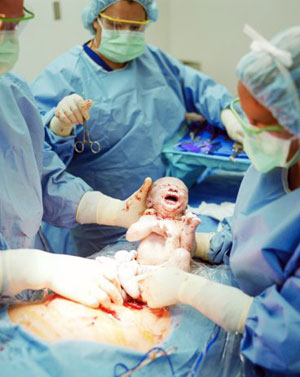
So you get dressed in your adorable little blue hat. They wheel you away and give you lots of anesthesia while your husband waits in the hallway for the go-ahead to come in. You're on your back, and you have a giant blue sheet draped in front of you. You feel pressure here and there, and your husband is telling you what's going on. Your newborn is pulled out of you, and they hold your babe above the curtain so you can get a look! They do major sucking because your baby didn't get a good massage from your vaginal wall on its way out, so there's extra fluid that must be removed. Your husband is peering over the curtain to get a better look, and you're stuck on your back. They finally bring you your baby burrito so you can give him a kiss and say hello. Then they stitch you back up and send you off to recovery from your major surgery.
And that's how it goes! Or, at least, that's how I've read and seen how it goes.
But have you ever heard of the Slow Cesarean? No? Neither had I, before I picked up this amazing book. It's another way of performing a C-section, and it pays close attention to details - and, guess what? It's slow.
-The drape that typically obscures a mom's view of her body is withdrawn as the baby emerges so she can see her baby being born
-At first, only the baby's head is removed from the uterus, allowing the baby to receive a few minutes of the benefit of a body massage as the uterus contracts
-Instead of quickly clamping and cutting the cord, the doctor leaves it intact and allows the baby to slowly acclimatize to the surroundings with support from the placenta's blood and oxygen
-As the baby seems to become more alert, the doctor hands the baby to the mom, who places her little newborn on her chest for skin-to-skin contact. This way bonding can begin. The baby awakens to the world hearing Mom's voice and smelling Mom's smell instead of being on a resuscitation table.
*Note: It's been proven that breast-feeding is easier to establish, and the baby is much more calm when a C-section is performed this way
There is another way! No one goes into pregnancy fantasizing a C-section as the end result. Well, scratch that. Some celebs (and average moms..) have been "picking" and "choosing" their baby's birthday by scheduling inductions for no reason other than it being a "good day" for them. I'm totally against this for a whole slew of reasons. Don't get me started. Or, please do, because this is my favorite topic.
--------------------------------------------
The book also lists the World Health Organization Recommendations for the Best Birth. I find this to be very interesting, and I couldn't agree more:
-The well-being of the new mother must be ensured through free access of a chosen member of her family during birth and throughout the postnatal period. In addition, the health team must provide emotional support
- Women must participate in decisions about their birth experiences
- The healthy newborn must remain with the mother whenever possible***
- Immediate breast-feeding should be encouraged even before the mother leaves the delivery room. Unrestricted mother-infant contact after the delivery and unrestricted breast-feeding reduce breast-feeding failure
- There is no justification for a hospital to have a Cesarean section rate of higher than 10-15%. Vaginal deliveries after a Cesarean section should be encouraged
- Electronic fetal monitoring should not be routine
- There is no indication for shaving pubic hair before delivery
- There is no indication for routine enemas before delivery
- The dorsal lithotomy position during labor and delivery is not recommended. Women must decide which position to adopt for delivery
- Induction of labor should be reserved for specific medical indications
- The routine administration of analgesic or anesthetic drugs should be avoided
- Artificial early rupture of membranes, as a routine process, is not justifiable
- Enhanced social and psychological support from caregivers reduces negative outcomes. Leaving women unattended during labor should be abandoned
- Separating healthy mothers and babies routinely should be abandoned*****
- Repeating Cesarean section routinely after previous C-sections should be abandoned
- Restricted maternal position during labor and delivery should be abandoned. Upright versus recumbent position during first and second stage reduces negative outcomes
- Performing episiotomy routinely should be abandoned
- Inducing labor routinely at less than 42 weeks gestation should be abandoned
- Prescribing sedatives or tranquilizers routinely should be abandoned
I've bolded the statements that I feel strongly about. At the top of my list, probably, would be the idea that for a healthy mother and child, the baby should go straight to the mother's chest for skin-to-skin contact. Not weighed. Not measured. Not slapped with goop on the eyes to protect from from the Chlamydia and Gonorrhea that their mother doesn't have. On the mommy's chest for the best bonding moment of their lives.
The point is: there are lots of options out there, and your doctor probably won't tell you about them. Your doctor has a bunch of other patients, so you have to do your research to know what's best for your birth.
And, Note: I've never given birth, so I don't really know what I'm talking about! I'm just spreading the word of Ricki Lake, because I highly agree with her and think she's on to something...
Check out her book or buy it. I got ALL my information in this post from her book, Your Best Birth
Visit her website to learn more about how you can have your best birth!